
Strengthen Your Gut: How a Healthy Gut Is Associated With Preventing Parkinson’s
Written By: Raquel Castro

Ever wondered about ways to prevent or slow down the development of dementia due to a genetic predisposition, environmental factors, or simply due to a general concern? Recent research finds that having a healthy gut can also support a healthy brain, which may contribute to preventing dementia. Neurodegeneration is known as the death of brain cells, which is caused by neurodegenerative diseases (Przedborski et al., 2003). Neurodegenerative diseases commonly appear amongst older individuals depending on environmental or genetic factors. Neurodegenerative diseases include Alzheimer’s Disease (AD), Parkinson’s Disease (PD), Huntington’s Disease (HD), and Amyotrophic Lateral Sclerosis (ALS). The purpose of this article is to further dive into the benefits of probiotic supplementation, as a healthy brain is strongly associated with a healthy gut and can prevent further development of the specific neurodegenerative disorder known as Parkinson’s Disease (PD).
What is Parkinson’s Disease (PD)?
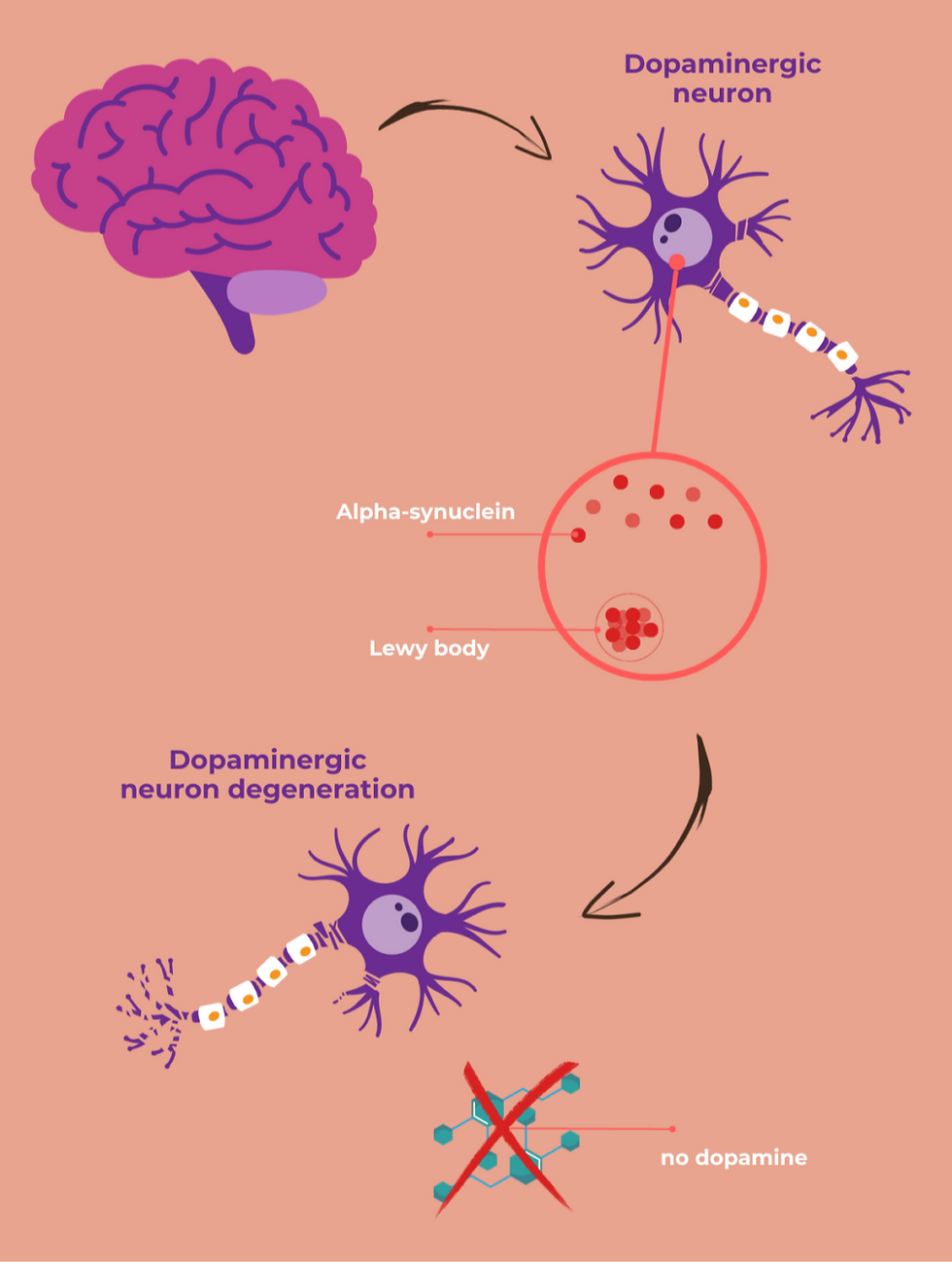
Parkinson’s Disease (PD) is a neurodegenerative disorder that is commonly associated with tremors, impaired gait, general slowness of motor movements, and limb stiffness. Additionally, non-motor symptoms associated with PD are: depression, anxiety, orthostatic hypotension, apathy, sleep disorders, hallucinations, and a loss of a sense of smell. Constipation, nausea, vomiting, delayed gastric emptying, hypersalivation, dysphagia, and gastroparesis are found to be associated with the symptoms of PD patients (Parkinson’s Foundation & Hsieh et al., 2020).
What Are Probiotics?
If you are unfamiliar with what probiotics are, chances are you have consumed them before! Probiotics are commonly found in yogurt, which contains healthy bacteria that support digestive health. It has been found that individuals with neurodegenerative diseases are more likely to have a lower number of healthy gut bacteria compared to healthy-brained individuals (Kesika et al., 2021, as cited in Xiang et al., 2022). Taking precautions like consuming probiotic supplements that contain the probiotic called Lactobacillus Plantarum can promote gut-brain health, as seen in Figures 1 and 2.

How May Probiotics Prevent Parkinson’s?
Relevant research suggests that the progression of neurodegenerative diseases may be delayed by probiotic supplementation. Metabolites like γ-aminobutyric acid, commonly known as GABA, serotonin (5-HT), and dopamine work together to support the overall functioning and regulation of mood and cognitive functions (Clark et al., 2014; Dinan & Cryan, 2017, as cited in Xiang et al., 2022). PD is strongly associated with dopamine production and the gut microbiome. It has been found that certain probiotics such as Lactobacillus Plantarum PS128 contribute specifically to the production of dopamine neurons (Lu et al., 2021).
Hsieh et al. (2020) discuss how there is a relationship between the brain and gastrointestinal (GI) dysfunctions. The researchers experimented on 10 genetically altered mice called MitoPark mice to test whether probiotic supplementation may support dopamine production and prevent the further deterioration of dopamine neurons. In this study, the researchers used a probiotic-food mixture consisting of six strains, including Lactobacillus Plantarum LP28 and Lactobacillus rhamnosus. This probiotic mixture was administered daily throughout a span of 24 weeks to the experimental group. The control group was given their regimen diet without including the probiotic mixture. To test if PD symptoms improved, biweekly, the mice would be required to participate in rotarod, balance beam, and gait analysis tests as shown in Figure 3.

As a result, the researchers discovered that there was a significant improvement in the general motor symptoms and cognition presented in the treated PD mice, as shown in Figure 4. This resulted in the finding that the supplementation of probiotics resulted in long-term positive effects and slower neurodegeneration (Hsieh et al., 2020).

Not only has the supplementation of probiotics for treating PD been tested on mice, but it has also been tested on humans and showed significant long-term effects. Xiang et al. (2022) conducted a meta-analysis to determine whether neurodegenerative diseases, including PD, can effectively be treated among humans. The researchers searched for every potential combination of research papers including probiotics, cognitive functioning, and PD. These findings resulted in the researchers concluding that there was a significant cognitive difference and improvement in the treated individuals with a neurodegenerative disease compared to the untreated individuals. Improvements in gene expression, biochemical indicators, and clinical features also resulted from this, as shown in Figure 5.

Conclusion
Neurodegeneration is a very unfortunate occurrence that affects people of a variety of backgrounds. Finding effective means to treat Parkinson’s Disease in any shape or form would be beneficial to every affected individual. Incorporating the supplementation of probiotics such as Neuralli® MP – PS128 probiotic medical food and BIOptimizers – Probiotic Breakthrough into one’s diet could help prevent the development of neurodegeneration. Further research must be conducted on this, as there has primarily been research on rodents compared to humans. The neuroscientific field is still developing, with hopes that advancements in brain health will become apparent.
Works Cited
Hsieh, T.-H., Kuo, C.-W., Hsieh, K.-H., Shieh, M.-J., Peng, C.-W., Chen, Y.-C., Chang, Y.-L., Huang, Y.-Z., Chen, C.-C., Chang, P.-K., Chen, K.-Y., & Chen, H.-Y. (2020). Probiotics alleviate the progressive deterioration of motor functions in a mouse model of parkinson’s disease. Brain Sciences, 10(4), 206. https://doi.org/10.3390/brainsci10040206
Lu, C.-S., Chang, H.-C., Weng, Y.-H., Chen, C.-C., Kuo, Y.-S., & Tsai, Y.-C. (2021). The add-on effect of lactobacillus plantarum PS128 in patients with parkinson’s disease: A pilot study. Frontiers in Nutrition, 8. https://doi.org/10.3389/fnut.2021.650053
Neurodegenerative diseases. Cleveland Clinic. (2026, April 14). https://my.clevelandclinic.org/health/diseases/24976-neurodegenerative-diseases
What is parkinson’s? Parkinson’s Foundation. (n.d.). https://www.parkinson.org/understanding-parkinsons/what-is-parkinsons
Xiang S, Ji J-L, Li S, Cao X-P, Xu W, Tan L and Tan C-C (2022) Efficacy and Safety of Probiotics for the Treatment of Alzheimer's Disease, Mild Cognitive Impairment, and Parkinson's Disease: A Systematic Review and Meta-Analysis. Front. Aging Neurosci. 14:730036. doi: 10.3389/fnagi.2022.730036

Comments